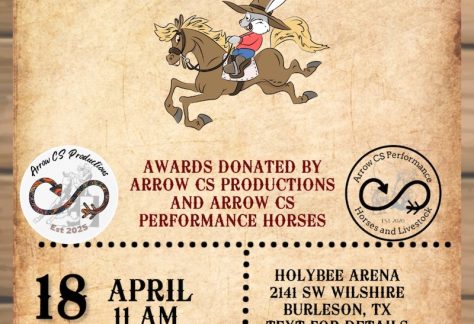
2nd Annual Run From the Relatives BRAT Pt Race 8 & 9 $4000 AddedDaily
Shepherds Valley Cowboy Church
8901 U.S. 67, Alvarado, TX 76009
Shepherds Valley Cowboy Church
8901 U.S. 67, Alvarado, TX 76009
Marshall City Arena
3310 Popular Street Marshall, TX 75671
Beauregard Arena
5515 Hwy 190, DeRidder, LA 70634
Limestone County Fairgrounds
922 North Tyus Street, Groesbeck, TX 76642
The plan being developed by the North American Veterinary Medical Education Consortium is being called a road map for the future of veterinary medicine in the United States. Specifically, the consortium wants to reshape veterinary education into a flexible system that will graduate veterinarians who can satisfy the rapidly changing needs of society, whether that involves extending the longevity of pets through the use of cutting-edge biotechnology or alleviating world hunger by maximizing production of animal protein. It’s a bold undertaking, one that NAVMEC Chair Bennie I. Osburn characterized this way: “This is probably the largest and
After it was wiped out in the U.S. in 1982, Equine Piroplasmosis, a blood infection affecting horses, apparently is reemerging in the country with 15 states so far reporting a detection of the disease. Efforts are under way to curb the spread of the disease, including formulating a vaccine. Additional information about the disease can be found at the AVMA Web site. SeattlePI.com/Pet Blogs
The southeast metro region has its first confirmed case of rabies in a skunk in more than 20 years, the Tri-County Health Department announced today. The stricken skunk was found on private property southwest of E-470 and Gartrell Road in Parker, near the border of Arapahoe and Douglas counties, the agency reported. The last rabid animal found in Douglas County was a bat in 2007. The virus in skunks has surged in recent years, according to the Colorado State University Extension Service. Besides Douglas County, rabid skunks have also been found in Adams, Arapahoe and El Paso
Canadian researchers said they were able to sequence the genes of a beef bull and a dairy bull, which could have significant implications for the dairy and beef industries. Aside from potentially yielding healthier and more cost-effective products, “understanding what genes contribute to specific cattle traits will also have spin-off applications related to other fields like human health and disease,” according to one of the researchers. PhysOrg.com
As expected, the National Thoroughbred Racing Association Safety and Integrity Alliance has updated its code of standards to include wagering security measures. The NTRA announced the code for 2010 in a March 17 release. Compliance standards now cover six areas: injury reporting and prevention; creating a safer racing environment; aftercare and transition of retired racehorses; medication and testing; jockey safety and health; and wagering security. Within those six categories, specific standards will have focus. Continue reading..
Two Nevada men face federal charges in connection with the shooting deaths of five Bureau of Land Management mustangs at the Buckhorn Herd Management Area in November 2009. Continue reading…
Horse owners in Tennessee who intentionally neglect their animals would face felony charges under a bill recently introduced into the state’s House of Representatives. HB 3386 amends Tennessee’s aggravated cruelty to animals statute to include horses and other livestock; current law applies to companion animals only. The bill also authorizes the courts to order those charged under the law to forfeit their animals. Continue reading…
Schaumburg, IL — Their numbers are dwindling at such a rate that our food supply may be in jeopardy – and that decline may continue as their educational debt continues to rise. These are just two of the challenges facing food animal veterinary medicine, one of the bulwarks of our food safety system. The American Veterinary Medical Association (AVMA), as part of its ongoing effort to bolster the number of food animal veterinarians in the United States, today announced a new initiative to help reverse the downward trend – an educational debt relief program for those veterinarians
$500,000 will be allotted, thanks to partnership with companies After Garrett R. Stewart graduates from the Kansas State University College of Veterinary Medicine this spring, he’ll go on to be a food animal practitioner in his hometown of Washington, Kan. He’ll have some company, too, as 28 of the 108 veterinary students who graduated in 2009 from K-State went into food animal or mixed animal practice. Thirty-seven graduates did so in 2008. Compared with what’s happening nationally, however, Stewart is considered a rarity. Food animal practitioners now make up fewer than 10 percent of the veterinarians in
More than two-dozen states now permit courts to bar convicted animal abusers from owning pets or even associating with animals — a nearly two-fold increase from 10 years ago — and three additional states are weighing passage of similar measures. “It’s not that animal abuse is more prevalent,” said one expert. “What has changed over the past few years is the recognition that animal abuse is often a warning sign for other types of violence and neglect.” The New York Times